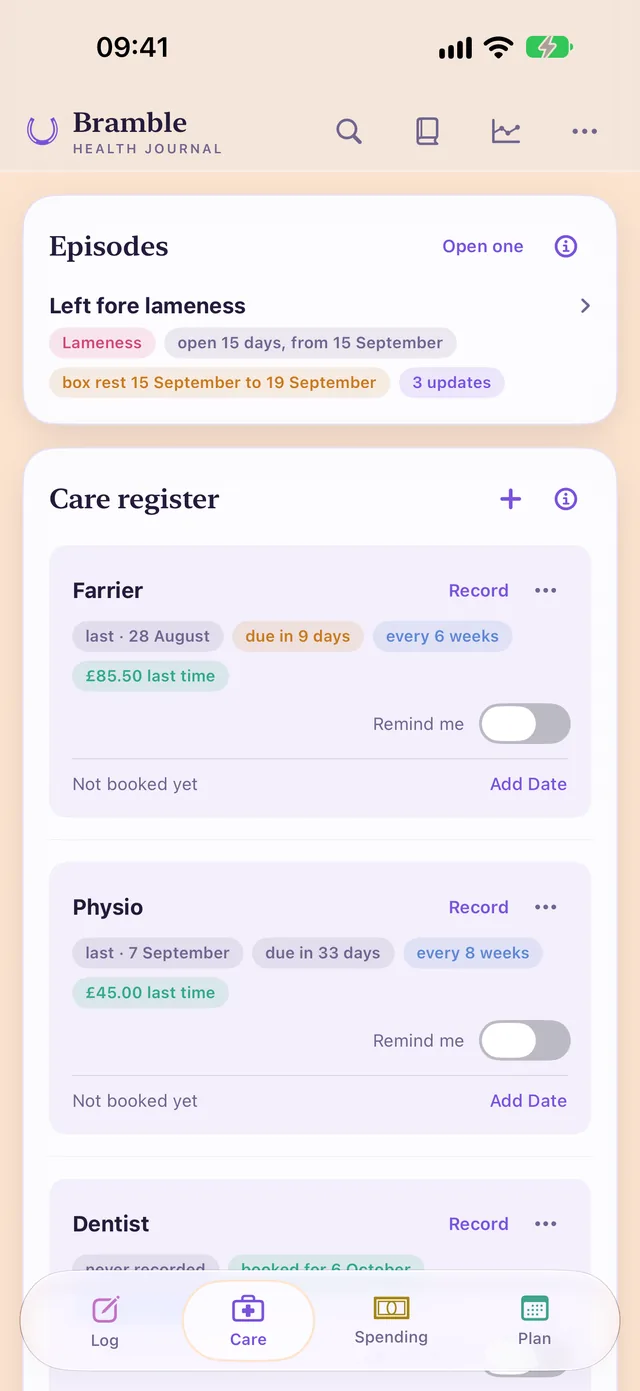
Farrier, vaccinations, worming, dentist and physio, kept in one care register. You enter what happened and choose the intervals for your horse.
The care register
What happened belongs in the history
Horse care has a lot of dates attached to it. The farrier's last visit, a
vaccination, worming, the dentist coming out, a physio appointment. They are separate
jobs, often with separate people, but they all belong to the same horse.
HorseDex keeps them in one care register. Each care item shows when it was last
done and, where you have set an interval, when it next falls due. The register holds
what is booked as well as what happened, so a future appointment and a completed visit
have their own place.
You can add care types of your own and hide the ones your horse does not have.
Farrier, dentist, physio, saddler, vet, worming and vaccinations are starting points,
rather than a list you have to fill in. A record can include what the visit cost.
Care holds the visit history and the dates ahead.
Your intervals
Due dates come from the dates you enter
You choose the interval for each care type for each horse. The next-due date is
calculated from the recorded last visit and that interval. A farrier visit and a
vaccination do not have to follow the same schedule, and neither do two different horses.
Some things have no repeating interval. Those simply keep a record of when they
happened. You do not have to turn a one-off visit into a recurring job to keep it in
the journal.
The interval is yours to enter, following the arrangements you make with the person
caring for your horse. HorseDex displays the resulting date. It does not choose a
vaccination or worming schedule, or decide when a horse needs a visit.
Booking
A reminder to put it in the diary
When enabled, care booking reminders use the due date calculated from your
record. There is a prompt about a month ahead and a chaser a fortnight before, giving
you time to arrange the appointment. Notifications need your device's permission.
Book the visit and those prompts go quiet. The register can then show the booking
alongside the care history. Once the visit has happened, recording it puts the actual
date into that history rather than leaving the booking as the only note of it.
These are reminders about dates you supplied and intervals you set. Keeping the
dates current keeps the register useful: an unrecorded visit is not part of the history
the app has to show you.
Alongside the journal
The visit and the rest of that day
A care record gives you the date and the cost of a visit. The dated journal keeps
your observations and other entries alongside it. When you look back, you have the
written record of both, without needing to reconstruct the day.
A cost entered on the Care page also counts on Spending. You can keep the visit
in the care register and read the cost with the rest of that horse's expenses. It is
the same recorded visit, seen from two useful places.